
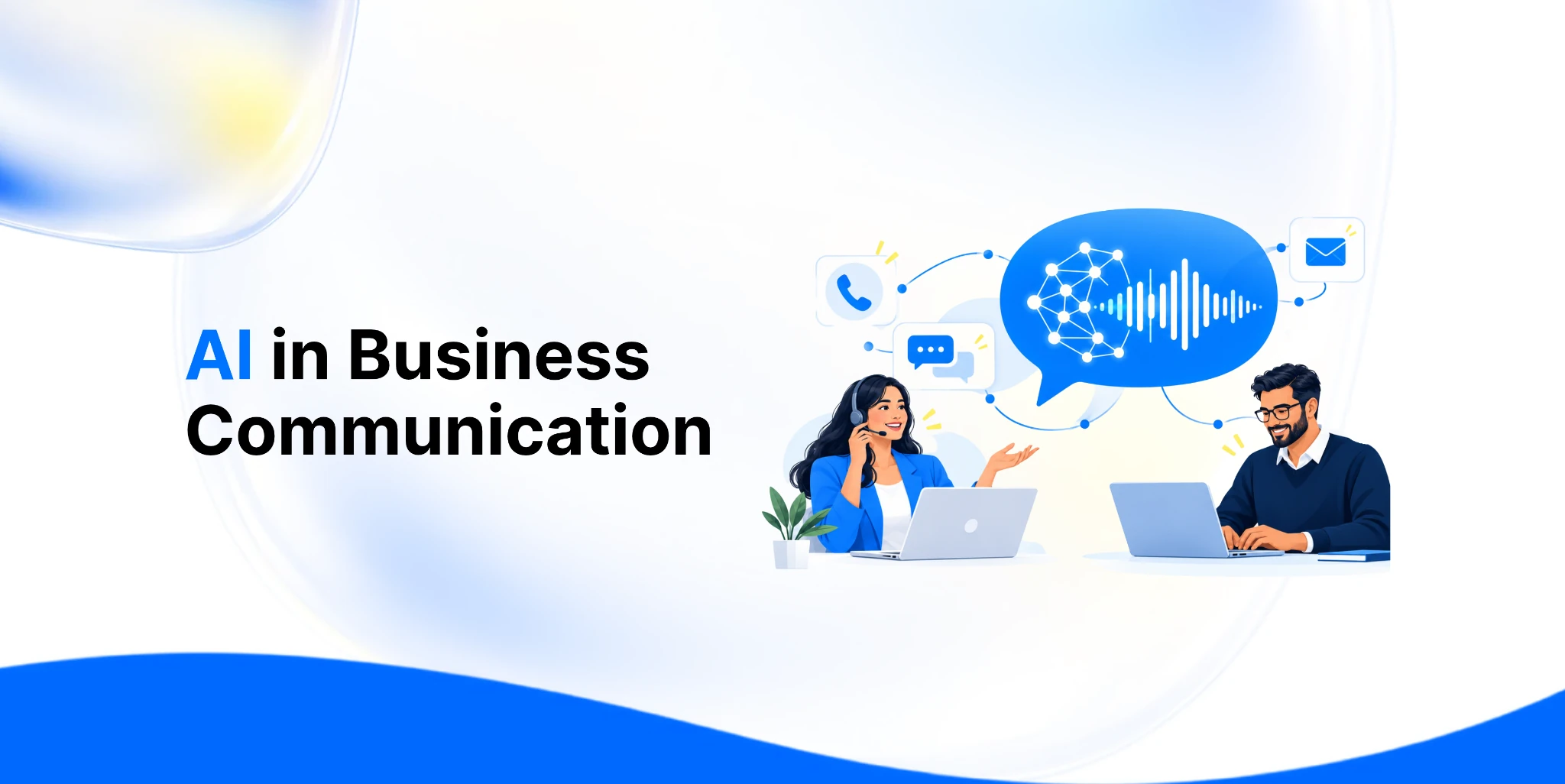
AI in business communication is making this possible. From AI-powered contact centers to intelligent chatbots and automated customer interactions, artificial intelligence is transforming how businesses communicate, serve customers, and grow.
In 2026, businesses are moving beyond basic automation toward intelligent communication systems that understand customer needs, personalize responses, and support human agents in real time.
But how exactly is AI used in business communication, and which applications deliver the most value?
Let's explore the top AI communication use cases, their benefits, and how businesses can use AI-powered customer service solutions to improve efficiency and customer experience.
What Is AI in Business Communication?
AI in business communication refers to the use of artificial intelligence technologies to automate, analyze, personalize, and improve interactions between businesses, customers, employees, and partners.
AI communication tools use technologies such as natural language processing (NLP), machine learning, conversational AI, and speech recognition to understand messages, generate responses, and automate communication workflows.
Common examples include AI voice agents, intelligent chatbots, automated email responses, AI call center software, real-time call analytics, and customer support automation.
Unlike traditional communication tools, AI-powered business communication platforms can analyze context, recognize customer intent, and recommend relevant actions.
For businesses, this means faster response times, improved customer engagement, more productive employees, and scalable communication operations.
Why Is AI Important in Business Communication in 2026?
Customer expectations are changing. People want immediate answers, personalized experiences, and consistent support across phone calls, email, live chat, and messaging platforms.
Traditional communication systems often struggle to meet these expectations, especially when businesses manage high call volumes or multiple communication channels.
AI helps address these challenges by automating repetitive tasks and giving employees better information during customer interactions.
According to research discussed by HubSpot, customer service leaders are actively exploring AI solutions to improve customer interactions. Industry research also highlights growing adoption of AI for automated resolution, agent assistance, and contact center operations.
The biggest benefits of AI in business communication include:
- 24/7 customer support: AI-powered systems can handle routine inquiries outside business hours.
- Faster response times: Automated workflows reduce waiting periods.
- Lower operational costs: Businesses can automate repetitive communication tasks.
- Personalized customer experiences: AI uses relevant customer data to tailor responses.
- Improved employee productivity: Teams spend less time on administrative tasks.
- Scalable customer communication: Businesses can handle growing interaction volumes more efficiently.
10 Powerful AI in Business Communication Use Cases
1. AI-Powered Customer Service and Support Automation
One of the most valuable AI business communication use cases is AI-powered customer service.
AI customer service software enables businesses to respond automatically to common questions, resolve routine issues, and route complex requests to human agents.
For example, an e-commerce company can use an AI customer support system to answer questions about order status, shipping, returns, and product availability.
Instead of waiting for a support representative, customers can receive assistance immediately.
AI customer service automation can help businesses reduce support workloads, improve first-response times, increase service availability, and maintain consistent communication.
For organizations handling large volumes of customer inquiries, automated customer service is often a practical starting point for AI adoption.
2. AI Call Center Software and Intelligent Call Routing
AI call center software is changing how businesses manage inbound and outbound customer calls.
Traditional call centers depend heavily on manual processes, fixed routing rules, and agent availability. AI-powered contact center solutions introduce intelligent automation that improves call handling.
For example, when a customer calls about a billing issue, an AI system can identify the reason for the call and direct the customer to the appropriate department.
Advanced AI contact center capabilities may include intelligent call routing, automated call transcription, real-time agent assistance, and post-call summaries.
These capabilities can reduce unnecessary transfers and help agents resolve issues more efficiently.
AI call center technology is particularly useful for telecommunications, healthcare administration, financial services, retail, and high-volume customer support operations.
3. AI Chatbots for 24/7 Business Communication
AI chatbots for business provide automated conversations through websites, mobile applications, and messaging channels.
Unlike traditional rule-based chatbots, modern conversational AI systems can interpret natural language and respond to more complex customer questions.
For example, a potential customer visiting a software company's website late at night can ask about product features, pricing options, or service availability.
An AI chatbot can provide approved information, collect contact details, and help schedule a consultation.
This allows businesses to engage prospects even when sales representatives are unavailable.
Business impact: Better lead engagement, improved response speed, reduced repetitive inquiries, and more opportunities to convert website visitors into qualified leads.
4. AI Sales Automation and Lead Qualification
AI in sales communication helps businesses identify promising prospects, personalize outreach, and automate routine follow-up activities.
Sales teams often spend significant time responding to inquiries, qualifying leads, and scheduling meetings.
AI sales automation tools can support these tasks by collecting relevant information and identifying leads that meet predefined criteria.
For example, a B2B company can use an AI voice agent or conversational chatbot to ask prospective customers about company size, business challenges, and purchasing timelines.
The system can then route qualified opportunities to the sales team.
This helps sales representatives prioritize high-value conversations instead of spending time on repetitive administrative tasks.
When integrated with customer relationship management (CRM) software, AI can also help maintain accurate customer records and improve sales follow-up.
5. Personalized Customer Communication Using AI
Personalization is a major advantage of AI-powered business communication.
Customers increasingly expect businesses to understand their preferences, previous interactions, and individual needs.
AI systems can analyze permitted customer data and interaction history to generate more relevant communication.
For example, a returning customer contacting a support team may receive assistance informed by previous purchases or unresolved support requests.
In sales, AI can help teams tailor product recommendations and follow-up messages based on customer interests.
Personalized AI communication can strengthen customer relationships, improve engagement, and create more relevant customer experiences.
However, businesses should use customer data responsibly and maintain appropriate privacy controls.
6. AI Email Automation and Smart Business Messaging
Email remains essential for customer support, sales, and internal communication.
AI email automation tools help businesses draft messages, categorize incoming inquiries, prioritize urgent requests, and recommend appropriate responses.
For example, an AI-powered communication platform can identify whether an incoming email concerns billing, technical support, or a sales opportunity.
It can then suggest a response or direct the request to the appropriate team.
AI can also help employees write clearer messages, summarize lengthy email conversations, and maintain consistent communication standards.
This is especially valuable for businesses managing large volumes of customer emails and support tickets.
7. AI Voice Agents for Automated Customer Calls
AI voice agents are becoming an important part of modern business communication.
An AI voice agent is software that uses speech recognition, conversational AI, and voice synthesis to interact with callers using spoken language.
Depending on its configuration and integrations, an AI voice agent can answer common questions, collect customer information, confirm appointments, provide basic account information, or transfer callers to human representatives.
For example, a healthcare clinic could use an AI voice agent to help patients request appointments, confirm operating hours, and receive scheduling information.
A real estate company could use similar technology to handle initial property inquiries and qualify potential buyers.
AI voice agents are particularly valuable for businesses that need scalable phone communication without relying entirely on additional staff.
8. AI-Powered Internal Team Communication
AI in business communication is not limited to customer-facing interactions.
Organizations also use artificial intelligence to improve internal collaboration and employee productivity.
AI communication assistants can summarize meetings, draft internal announcements, organize knowledge, and help employees locate relevant company information.
For example, a customer support manager can use AI-generated summaries to identify recurring customer issues and share actionable insights with the team.
Similarly, employees can use AI-powered knowledge assistants to find approved procedures without manually searching through multiple documents.
These applications can reduce communication delays and help teams make better-informed decisions.
9. AI Sentiment Analysis and Customer Experience Monitoring
Understanding customer emotions and feedback is essential for improving communication quality.
AI sentiment analysis helps businesses identify positive, negative, or neutral language in customer conversations.
When used with speech analytics and customer interaction data, AI can help contact center managers identify recurring complaints, service challenges, and potential customer dissatisfaction.
For example, if multiple customers express frustration about delayed deliveries, AI analytics may help reveal the trend before it becomes a larger operational problem.
Businesses can use these insights to improve customer service training, refine communication strategies, and identify areas requiring attention.
Sentiment analysis is not always accurate, particularly across languages, accents, and contexts, so important decisions should include human review.
10. AI Omnichannel Communication and Customer Engagement
Customers communicate with businesses through multiple channels, including phone calls, email, websites, live chat, and messaging applications.
Managing these channels separately can create fragmented customer experiences.
AI-powered omnichannel communication helps businesses organize interactions and maintain relevant context across supported channels.
For example, a customer might begin an inquiry through a website chatbot and later continue the conversation with a human support agent.
With an integrated omnichannel contact center solution, the agent can access relevant conversation history instead of asking the customer to repeat everything.
This approach improves communication continuity and helps businesses provide more consistent support.
AI in Business Communication: Industry-Specific Examples
AI communication solutions can support different industries depending on their customer needs, communication volumes, and operational requirements.
The best AI use case depends on the volume, complexity, and business value of the conversations being handled.
How AI-Powered Contact Centers Improve Business Communication
An AI-powered contact center combines customer communication technology with artificial intelligence to improve how businesses handle calls, messages, and support requests.
Unlike traditional call center systems, modern AI contact center solutions can support automated interactions, intelligent routing, customer analytics, and real-time assistance for agents.
This allows businesses to balance automation with human expertise.
For example, AI can handle a routine request for operating hours, while a human agent manages a sensitive complaint or complex account issue.
The result is a more flexible customer communication model where employees can focus on conversations that require judgment, empathy, and problem-solving.
Businesses evaluating AI contact center software should prioritize solutions that support their existing communication workflows, offer reliable integrations, and provide clear performance reporting.
How to Implement AI in Business Communication Successfully
Adopting AI communication tools requires more than selecting new software.
Businesses should begin by identifying communication challenges that create measurable operational problems.
A company experiencing high call volumes may prioritize AI call routing and voice automation. A business struggling with website lead conversion may focus on AI chatbots and automated lead qualification.
Once the use case is defined, businesses should evaluate their communication channels, existing CRM systems, customer data requirements, and employee workflows.
A successful implementation should also include human escalation paths, data privacy safeguards, regular quality testing, and ongoing performance monitoring.
Key metrics include average response time, first-contact resolution, customer satisfaction (CSAT), average handling time, lead conversion rate, and cost per interaction.
By measuring these outcomes, businesses can determine whether their AI communication investments are delivering meaningful results.
What Is the Future of AI in Business Communication?
The future of AI in business communication is moving toward more intelligent, connected, and proactive customer interactions.
Rather than simply responding to questions, AI systems are increasingly being designed to complete defined tasks, retrieve relevant information, and support multi-step customer workflows.
Emerging developments include agentic AI, advanced voice AI, real-time conversational analytics, multilingual support, and deeper CRM integrations.
Research from contact center technology providers highlights the growing importance of automated resolution, AI-assisted agents, and human oversight in modern customer experience strategies.
However, successful adoption will depend on accuracy, transparency, security, and the ability to transfer complex conversations to human representatives.
Businesses that combine AI automation with strong customer service processes will be better positioned to deliver efficient and personalized communication experiences.
Frequently Asked Questions About AI in Business Communication
1. What are the main uses of AI in business communication?
AI in business communication is used for customer service automation, AI chatbots, intelligent call routing, email automation, sales lead qualification, voice agents, sentiment analysis, and internal collaboration. These applications help businesses respond faster, improve productivity, and manage customer interactions more efficiently.
2. How does AI improve customer communication?
AI improves customer communication by providing faster responses, automating repetitive inquiries, personalizing interactions, and supporting 24/7 customer service. AI-powered contact center solutions also help businesses route conversations efficiently and provide human agents with relevant customer information.
3. What is the best AI solution for business communication?
The best AI solution depends on a company's communication needs. Businesses managing high call volumes may benefit from AI contact center software and voice agents, while organizations focused on website engagement may prioritize AI chatbots. A comprehensive solution should support automation, integrations, analytics, and human-assisted communication.
4. Can AI replace human agents in business communication?
AI can automate many routine communication tasks, but it cannot reliably replace human agents in every situation. Complex complaints, sensitive issues, negotiations, and interactions requiring empathy or judgment still benefit from human involvement. The most effective approach combines AI automation with human expertise.
Blog Summary: Key Takeaways
AI in business communication helps organizations automate customer interactions, improve response times, personalize communication, and scale customer support operations.
The most impactful use cases include AI-powered customer service, intelligent call routing, AI chatbots, sales automation, AI voice agents, email automation, and omnichannel customer engagement.
For businesses seeking measurable improvements, AI-powered contact center solutions offer a practical way to streamline communication while supporting human agents.
The key to successful AI adoption is selecting the right use cases, integrating AI with existing business systems, and continuously measuring customer experience and operational performance.
Transform Your Business Communication With Brightcall
Businesses need more than traditional calling systems to meet modern customer expectations. They need intelligent communication solutions that support efficiency, scalability, and better customer experiences.
Brightcall is a leading AI-powered contact center solution designed to help businesses modernize customer communication and improve sales and support workflows.
With Brightcall, businesses can explore smarter ways to manage customer interactions, optimize communication processes, and create more efficient customer engagement experiences.
Whether your goal is to improve call center performance, streamline customer support, or build a more scalable communication strategy, choosing the right AI contact center solution is an important step toward sustainable growth.
Ready to transform your business communication with AI?
Book a free consultation with Brightcall today and discover how an AI-powered contact center solution can help your business improve customer engagement, streamline operations, and unlock new growth opportunities.